
E-Commerce Complete Guide 2026: Start Your Online Store in Pakistan
Welcome to the complete e-commerce guide for Pakistan. Whether you want to start a dropshipping store, sell on Daraz, or build a brand on Shopify – this guide covers everything you need to know.
This guide is designed for beginners in Pakistan who want to start an online business with zero experience. No fluff, no hype. Just real, actionable steps to help you start and grow your e-commerce store.
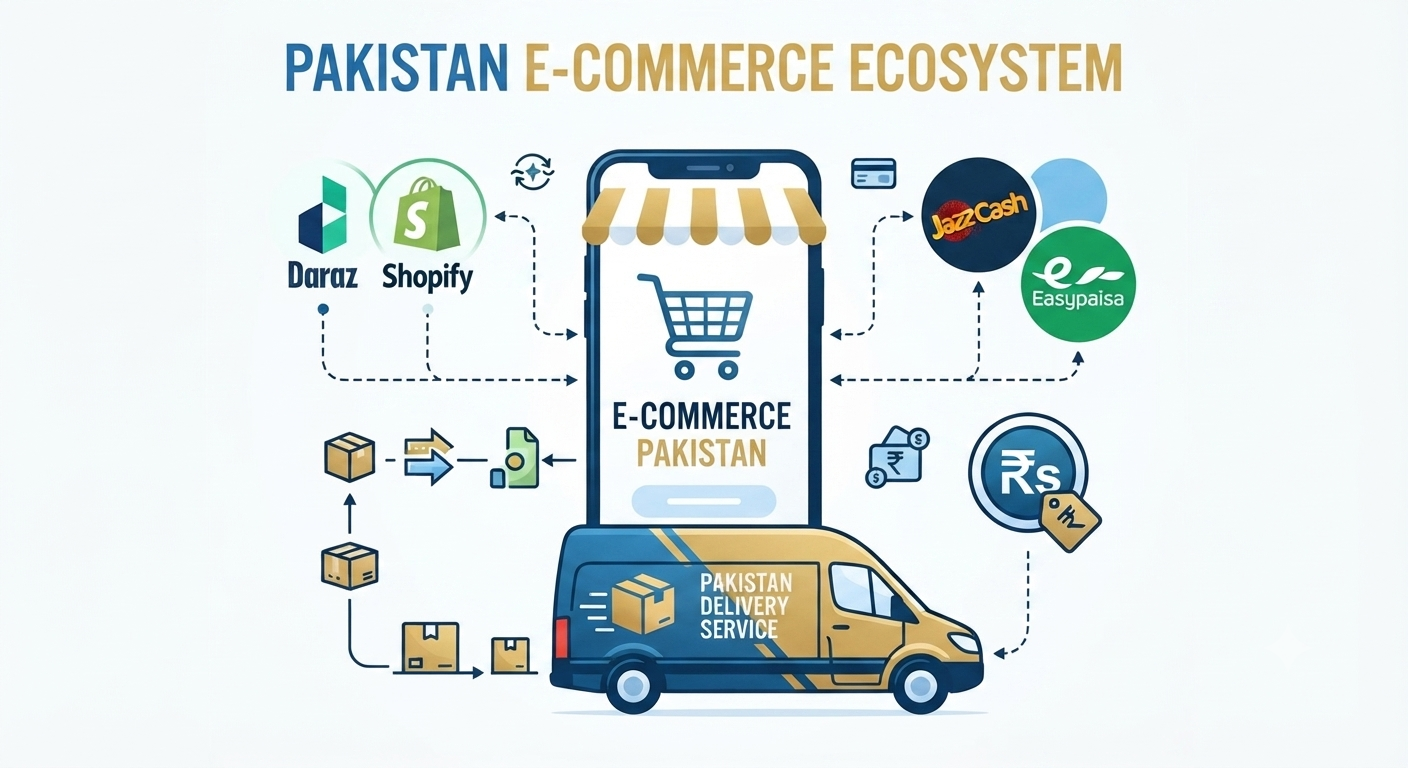
What You’ll Learn in This E-Commerce Guide
- 📖 What is E-Commerce?
- 🏢 Types of E-Commerce (B2C, B2B, C2C, C2B, D2C)
- 📦 E-Commerce Business Models (7 Models)
- 🛒 E-Commerce Platforms (Shopify, WooCommerce, Daraz, Amazon)
- 🛠️ Tools & Resources for E-Commerce
- 📊 Investment & Profit Analysis
- 🌍 E-Commerce in Pakistan (COD, RTO, Logistics)
- 📈 Marketing & Growth Strategies
- 👥 Team Requirements
- 📋 Legal Compliance in Pakistan
- ✅ Success vs Failure Analysis
- 🚀 Emerging Trends in E-Commerce
- ❓ Frequently Asked Questions
- 💼 Get Professional Help
📖 What is E-Commerce?
E-Commerce (Electronic Commerce) refers to the buying and selling of goods or services over the internet. It includes everything from online retail stores, digital marketplaces, and subscription services.
- 🌍 Global e-commerce sales reached $6.3 trillion in 2024
- 🇵🇰 Pakistan’s e-commerce market is growing at 30% annually
- 📱 65% of online purchases happen on mobile phones
- 🇵🇰 35% of Pakistanis now shop online
- 📦 60% of e-commerce orders in Pakistan are Cash on Delivery (COD)
E-Commerce vs Traditional Business
| Feature | E-Commerce | Traditional Business |
|---|---|---|
| Store Location | Online (Anywhere) | Physical (Fixed location) |
| Operating Hours | 24/7 | Limited hours |
| Customer Reach | Global | Local |
| Inventory | Can be zero (dropshipping) | Physical inventory required |
| Rent | No physical rent | High rent costs |
| Staff | Minimal | Multiple staff needed |
💡 Key Takeaway: E-commerce offers lower costs, wider reach, and more flexibility than traditional business. It’s the future of retail, especially in Pakistan where internet penetration is growing rapidly.
🏢 Types of E-Commerce (By Customer Type)
E-Commerce is divided into different categories based on who is buying from whom. Understanding these types helps you choose the right business model.
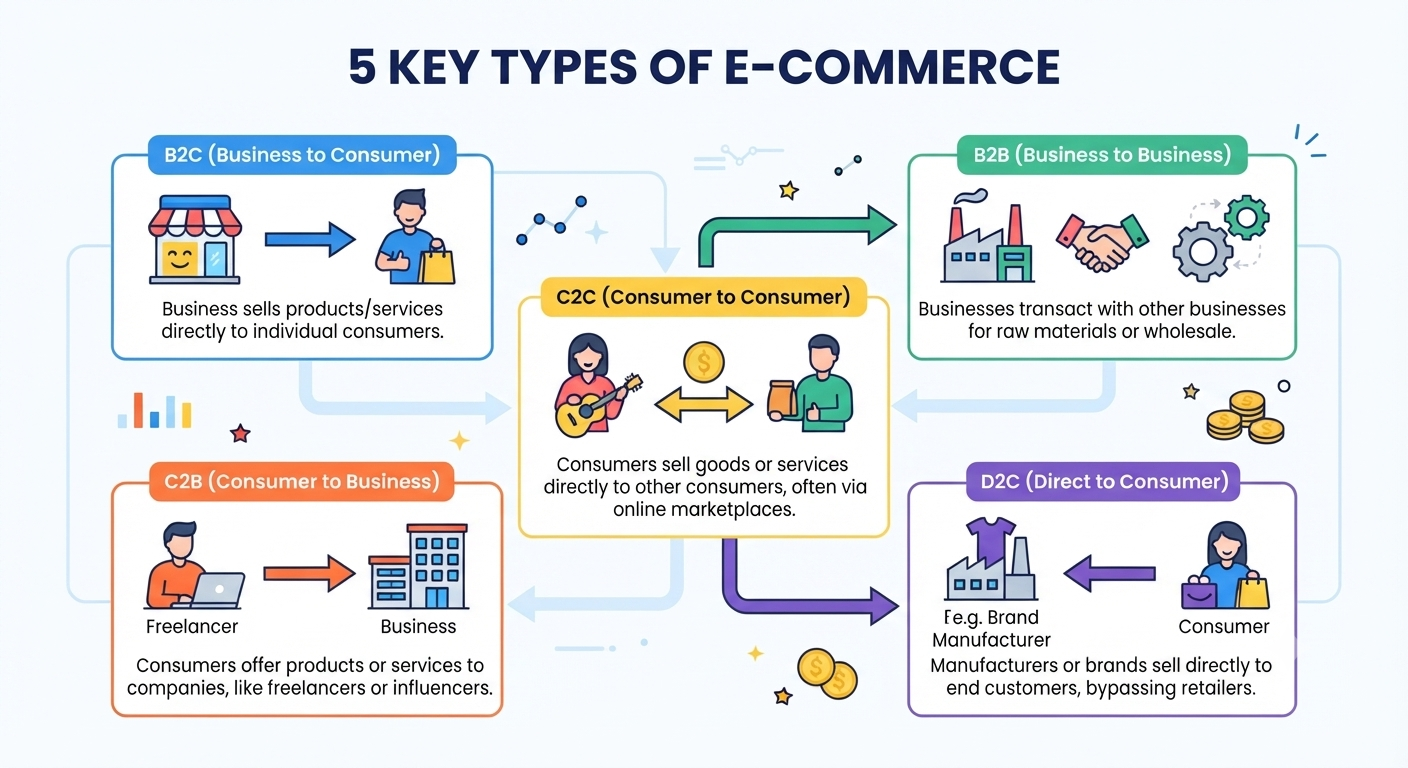
1. B2C (Business to Consumer)
The most common model. Businesses sell products directly to consumers.
- Examples: Daraz, Amazon, Shopify stores, Nike.com
- Best for: Anyone starting an online store
- Investment: $100-$500
- Profit Margin: 10-40%
💡 Pakistan Example: Daraz is the largest B2C platform in Pakistan with millions of daily visitors.
2. B2B (Business to Business)
Businesses sell products or services to other businesses.
- Examples: Alibaba, TradeKey, wholesale suppliers
- Best for: Wholesale, bulk orders, manufacturing
- Investment: $1000-$10,000
- Profit Margin: 10-30%
💡 Pakistan Example: Many textile manufacturers in Pakistan use B2B platforms to sell to international buyers.
3. C2C (Consumer to Consumer)
Consumers sell products directly to other consumers.
- Examples: OLX, Etsy, eBay, Facebook Marketplace
- Best for: Selling used items, handmade products, collectibles
- Investment: $0-$100
- Profit Margin: Variable
💡 Pakistan Example: OLX Pakistan is widely used for buying and selling used cars, phones, and furniture.
4. C2B (Consumer to Business)
Consumers offer products or services to businesses.
- Examples: Freelancing (Upwork, Fiverr), influencer marketing, stock photography
- Best for: Freelancers, content creators, photographers
- Investment: $0-$50
- Profit Margin: 50-90%
💡 Pakistan Example: Pakistan is among the top 5 freelancing countries globally with millions of freelancers on Upwork and Fiverr.
5. D2C (Direct to Consumer)
Brands sell directly to consumers without middlemen or retailers.
- Examples: Brand websites (Nike, Apple, local clothing brands)
- Best for: Building a strong brand identity
- Investment: $500-$5000
- Profit Margin: 30-60%
💡 Pakistan Example: Many Pakistani clothing brands now sell D2C through their own websites instead of just relying on Daraz.
📦 E-Commerce Business Models (7 Models Explained)
Here are the 7 most popular e-commerce business models in 2026. Each model has different investment, process, and success rate. Choose the one that fits your budget and skills.
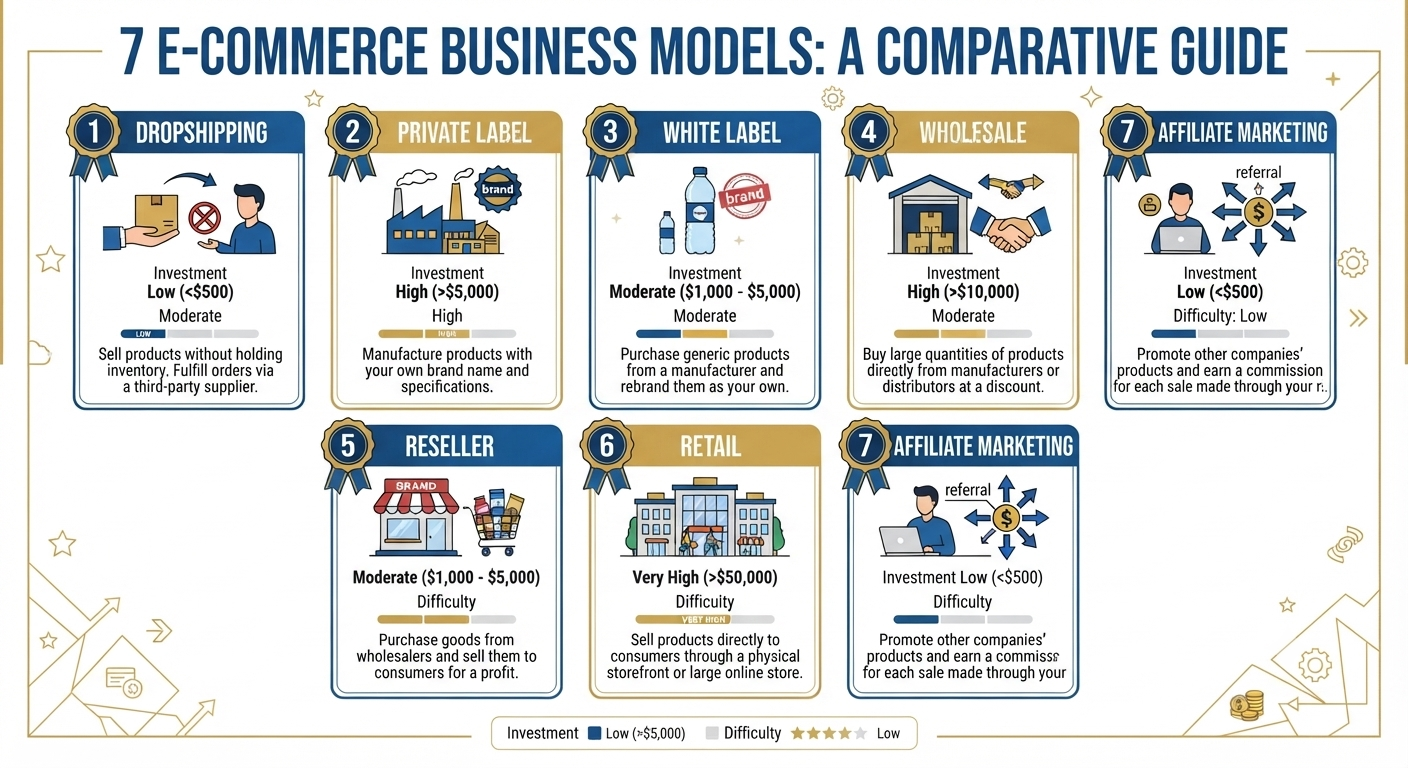
Model 1: Dropshipping
What is Dropshipping? You sell products online without holding inventory. When a customer places an order, the supplier directly ships the product to the customer.
How It Works:
- Create a Shopify or WooCommerce store
- Import products from AliExpress or CJ Dropshipping
- Customer places an order on your store
- You forward the order to the supplier
- Supplier ships the product directly to the customer
Pros: ✅ Low investment ($100-$300) ✅ No inventory risk ✅ Easy to start
Cons: ❌ Long shipping times ❌ Product quality issues ❌ RTO challenges in Pakistan
Investment: $100-$500
Difficulty: Medium
Success Rate: 20-30%
Pakistan-Specific:
- Daraz dropshipping is also possible
- Local suppliers can reduce shipping time
- RTO (Return to Origin) is a major challenge
➡️ Read Complete Dropshipping Guide →
Model 2: Private Label
What is Private Label? You buy generic products from a manufacturer, put your own brand name on them, and sell them as your own brand.
How It Works:
- Find a manufacturer (Alibaba or local)
- Request product samples
- Quality check the products
- Place bulk order with your branding
- Create your packaging and logo
- Sell on Amazon, Daraz, or your website
Pros: ✅ Higher profit margins (30-60%) ✅ Brand building ✅ Product control
Cons: ❌ High MOQ (Minimum Order Quantity) ❌ Inventory risk ❌ Quality control challenges
Investment: $500-$5000
Difficulty: Medium-High
Success Rate: 30-40%
Pakistan-Specific:
- Local manufacturers for textiles, leather, sports goods
- Daraz is excellent for private label products
- Pakistan’s export quality is recognized globally
➡️ Read Complete Private Label Guide → (Link to be added)
Model 3: White Label
What is White Label? Similar to private label, but the product already exists in the market. You rebrand an existing product and sell it under your name.
How It Works:
- Find a white label supplier
- Add your branding (logo, packaging)
- Sell as your own product
Pros: ✅ Faster than private label ✅ Lower MOQ ✅ Less product development
Cons: ❌ Less product uniqueness ❌ More competition
Investment: $300-$2000
Difficulty: Medium
Success Rate: 25-35%
Pakistan-Specific: White label supplements, cosmetics, and electronics are popular in Pakistan.
➡️ Read Complete White Label Guide → (Link to be added)
Model 4: Wholesale
What is Wholesale? Buy products in bulk from manufacturers and sell them to retailers or other businesses (B2B model).
How It Works:
- Order bulk products from manufacturer
- Store in warehouse
- Sell to retailers or businesses
- Manage inventory and logistics
Pros: ✅ High volume sales ✅ Established demand ✅ Long-term relationships
Cons: ❌ High investment ❌ Storage costs ❌ Price competition
Investment: $1000-$10,000
Difficulty: Very High
Success Rate: 40-50%
Pakistan-Specific: Textile, leather, and sports goods wholesale are famous in Pakistan.
➡️ Read Complete Wholesale Guide → (Link to be added)
Model 5: Reseller
What is Reselling? Buy products from a brand or supplier and sell them through your own channels (social media, WhatsApp, website) at a markup.
How It Works:
- Get permission from the brand
- Buy products at wholesale/discount rates
- Sell at retail prices on your platforms
- Earn the profit margin
Pros: ✅ Low investment ✅ No product development ✅ Established brand trust
Cons: ❌ Limited profit margins ❌ Cannot control pricing ❌ Competition with other resellers
Investment: $100-$1000
Difficulty: Low-Medium
Success Rate: 50-60%
Pakistan-Specific: Clothing, cosmetics, and electronics reselling is very popular on Instagram and WhatsApp.
➡️ Read Complete Reseller Guide → (Link to be added)
Model 6: Retail
What is Retail? Traditional or online store where you sell products directly to consumers (B2C model).
How It Works:
- Source products from wholesalers or manufacturers
- Set up a store (physical or online)
- Display products and manage inventory
- Sell to customers and handle delivery
Pros: ✅ Full control over pricing ✅ Brand building ✅ Customer relationship
Cons: ❌ Higher investment ❌ Inventory management ❌ Competition
Investment: $500-$5000
Difficulty: Medium
Success Rate: 30-40%
Pakistan-Specific: Hybrid retail (physical store + online presence) is growing in Pakistan.
➡️ Read Complete Retail Guide → (Link to be added)
Model 7: Affiliate Marketing
What is Affiliate Marketing? Promote other companies’ products and earn a commission on each sale. No inventory, no shipping, no customer service.
How It Works:
- Join an affiliate program (Daraz Affiliate, Amazon Affiliate)
- Get unique affiliate links for products
- Share links on your blog, social media, or YouTube
- Earn commission when someone buys through your link
Pros: ✅ Zero investment ✅ No inventory ✅ Work from anywhere
Cons: ❌ Commission-based only ❌ Need traffic ❌ Payment delays
Investment: $0-$50
Difficulty: Low
Success Rate: 40-50%
Pakistan-Specific: Daraz Affiliate Program is very popular in Pakistan. You can also join Amazon Affiliate (international).
➡️ Read Complete Affiliate Marketing Guide → (Link to be added)
🛒 E-Commerce Platforms
Here are the top platforms to build your online store. Each platform has different features, pricing, and Pakistan-specific support.
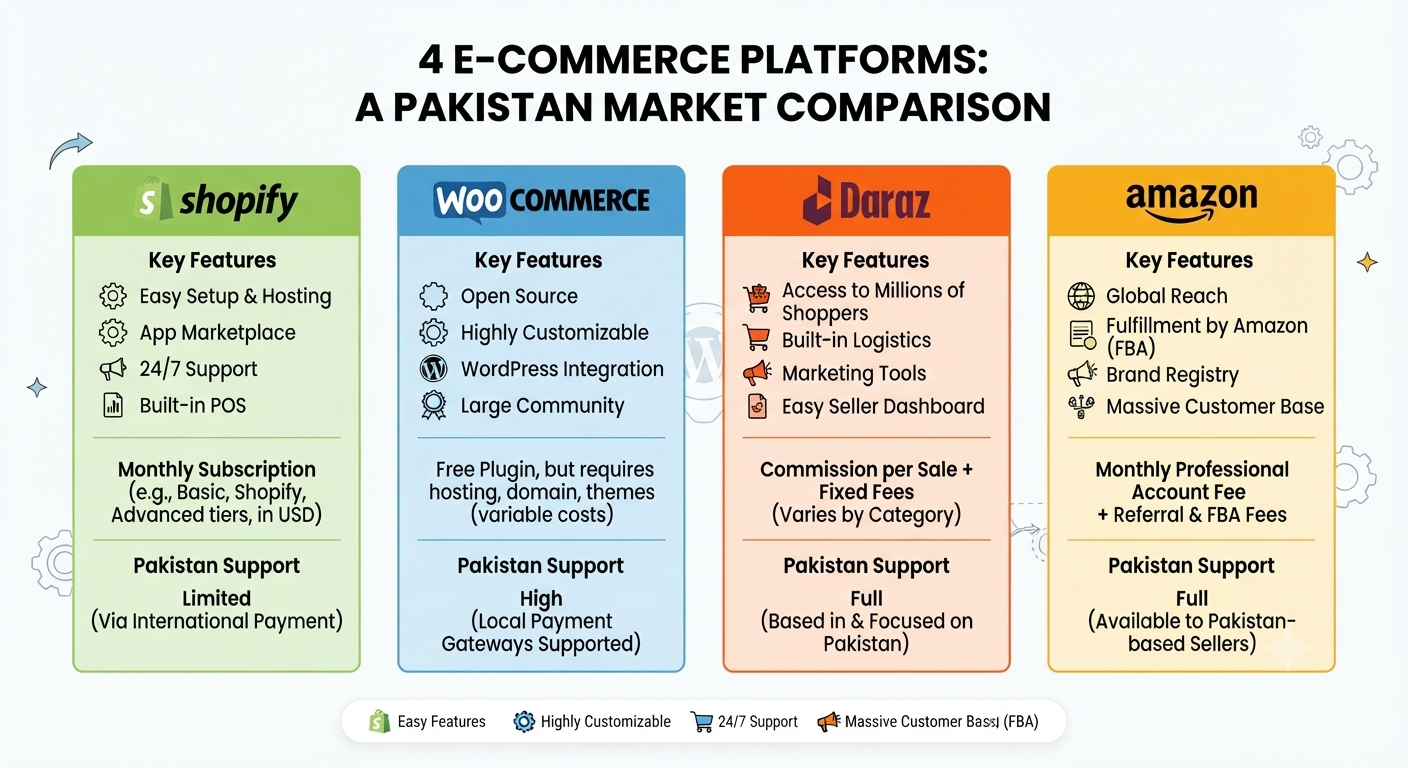
1. Shopify
Best for: Beginners who want an all-in-one solution without coding.
Key Features:
- 100+ free themes
- Payment gateway integration (Stripe, PayPal, 2Checkout)
- Inventory management
- SEO optimized
- Mobile responsive
- Dropshipping apps (Oberlo, DSers)
Pricing: $29/month (Basic plan)
Pakistan Support:
- ⚠️ Shopify Payments not available in Pakistan
- ✅ Use 2Checkout, PayPro, or JazzCash plugins
- ✅ COD (Cash on Delivery) supported via apps
Pros: ✅ Easy setup ✅ All-in-one ✅ Great support
Cons: ❌ Monthly fees ❌ Transaction fees ❌ Limited customizations
➡️ Read Complete Shopify Guide → (Link to be added)
2. WooCommerce
Best for: WordPress users who want full control and no monthly fees.
Key Features:
- 100% free (open source)
- Full customization
- 500+ extensions
- SEO friendly
- Complete ownership
Pricing: Free (hosting + domain extra)
Pakistan Support:
- ✅ JazzCash and Easypaisa plugins available
- ✅ COD (Cash on Delivery) support
- ✅ Local shipping plugins
- ✅ Pakistan-specific payment gateways
Pros: ✅ Free ✅ Full control ✅ Pakistan-friendly
Cons: ❌ Requires WordPress knowledge ❌ Hosting costs ❌ Security updates needed
➡️ Read Complete WooCommerce Guide → (Link to be added)
3. Daraz Seller Center
Best for: Pakistan sellers who want an existing audience.
Key Features:
- Built-in audience (millions of daily visitors)
- Logistics support (Daraz Express)
- Payment protection
- COD support
- Seller training programs
Pricing: Free (commission on each sale)
Pakistan Support:
- ✅ #1 platform in Pakistan
- ✅ Dedicated Pakistan seller support
- ✅ Marketing campaigns for sellers
- ✅ Daraz handles logistics
Steps to Start:
- Register on Daraz Seller Center
- Upload product listings
- Set pricing and inventory
- Start receiving orders
- Ship via Daraz Express
- Get payments to your account
Pros: ✅ Built-in traffic ✅ Easy start ✅ Pakistan-focused
Cons: ❌ Commission on sales ❌ Strict policies ❌ Competition
➡️ Read Complete Daraz Seller Guide → (Link to be added)
4. Amazon Seller Central
Best for: Global sellers targeting international markets.
Key Features:
- Global reach (USA, UK, Europe, UAE)
- FBA (Fulfillment by Amazon)
- Prime delivery
- Customer trust
- Advanced analytics
Pricing: $39.99/month (Professional plan)
Pakistan Support:
- ⚠️ Pakistani sellers can sell on Amazon
- ✅ Pakistan is eligible for Amazon FBA
- ✅ Use third-party logistics if not in USA
Pros: ✅ Massive audience ✅ FBA convenience ✅ Trusted platform
Cons: ❌ High fees ❌ Strict policies ❌ Returns and refunds
➡️ Read Complete Amazon Guide → (Link to be added)
🛠️ Tools & Resources for E-Commerce
Here are essential tools you need to run a successful e-commerce store. Each tool serves a specific purpose.
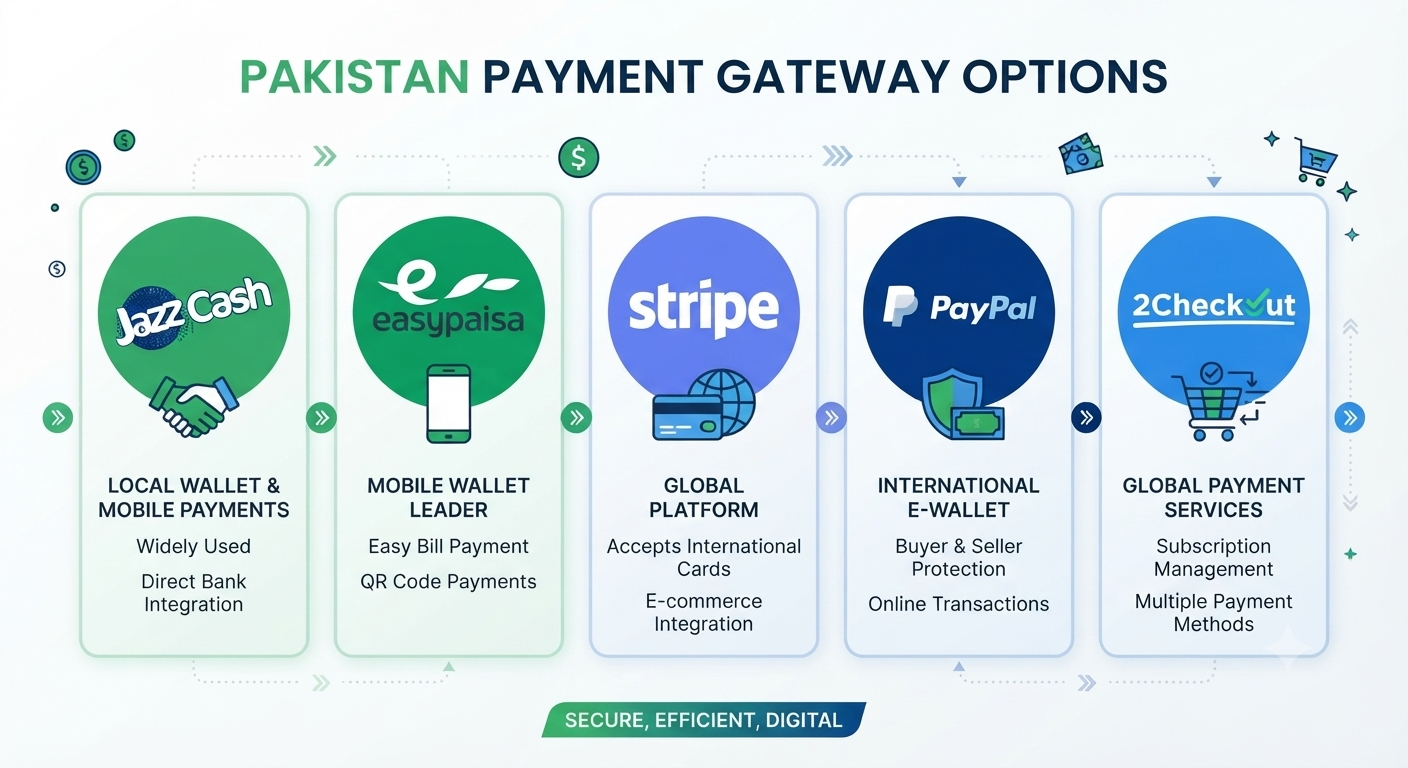
Payment Gateways (Pakistan)
| Gateway | Best For | Fees | Pakistan Support |
|---|---|---|---|
| JazzCash | Local payments, mobile wallets | 1.5-2.5% | ✅ Pakistan |
| Easypaisa | Local payments, mobile wallets | 1.5-2.5% | ✅ Pakistan |
| Stripe | International, credit cards | 2.9% + $0.30 | ⚠️ Limited |
| PayPal | International, freelancers | 4.4% + fee | ⚠️ Limited (Pakistan) |
| 2Checkout | International, easy setup | 3.5% + $0.35 | ✅ Pakistan |
Inventory Management Tools
- TradeGecko: Best for small businesses
- Zoho Inventory: Free for small businesses
- Stocky: Shopify inventory management
- Ordoro: Inventory + shipping management
Marketing Tools
- Facebook Ads Manager: Social media advertising
- TikTok Ads Manager: TikTok advertising
- Google Ads: Search and shopping ads
- Canva: Design social media posts
- Mailchimp: Email marketing
- Klaviyo: E-commerce email marketing
Analytics Tools
- Google Analytics: Free website analytics
- Meta Pixel: Facebook conversion tracking
- Hotjar: User behavior tracking
- Google Search Console: SEO performance
➡️ Read Complete Tools Guide → (Link to be added)
📊 Investment & Profit Analysis
Here is a detailed comparison of investment, profit margin, and break-even time for each e-commerce model.
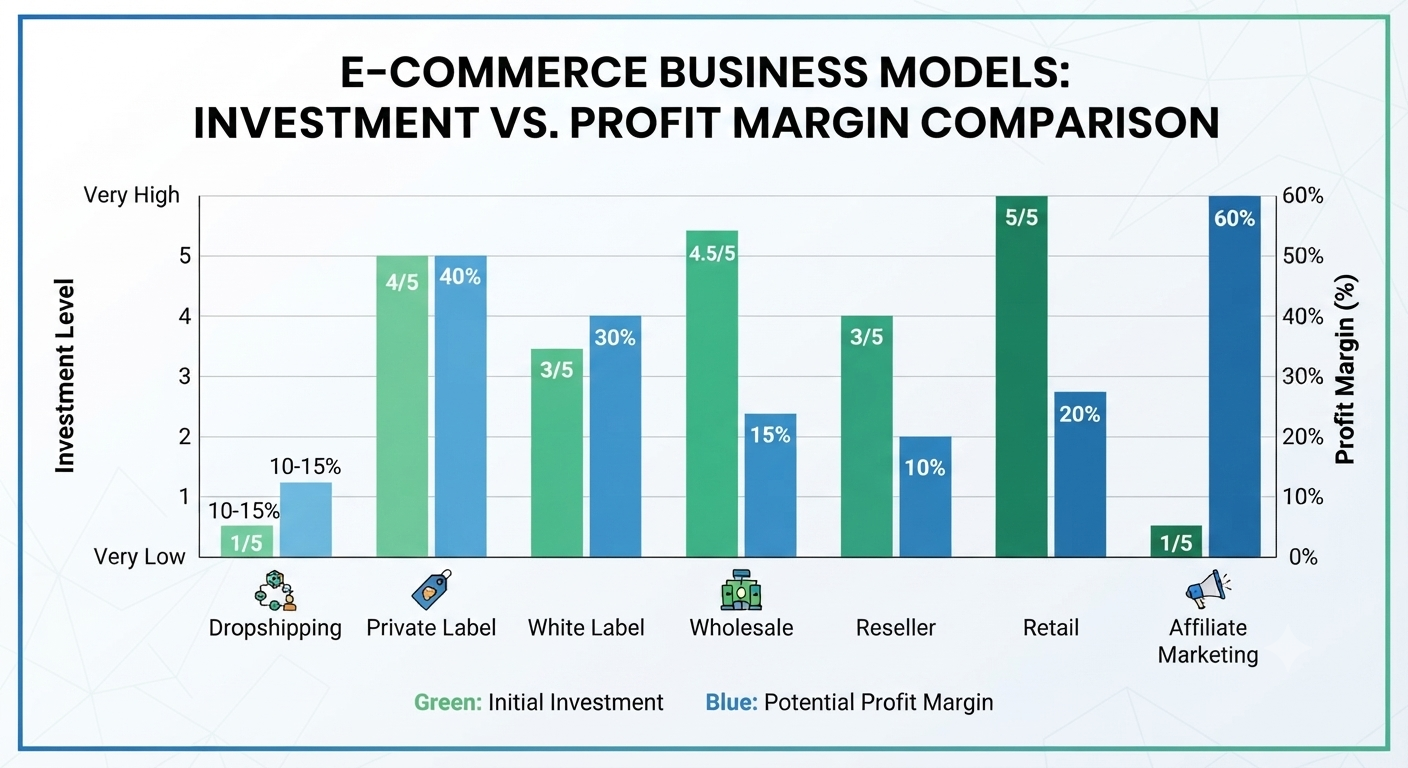
Investment Comparison Table
| Model | Investment | Monthly Cost | Profit Margin | Break-even Time |
|---|---|---|---|---|
| Dropshipping | $100-500 | $50-100 | 10-30% | 1-2 months |
| Private Label | $500-5000 | $100-300 | 30-60% | 3-6 months |
| White Label | $300-2000 | $50-150 | 20-40% | 2-4 months |
| Wholesale | $1000-10000 | $200-500 | 10-30% | 6-12 months |
| Reseller | $100-1000 | $20-50 | 10-30% | 2-4 weeks |
| Retail | $500-5000 | $100-300 | 15-40% | 3-6 months |
| Affiliate | $0-50 | $0-20 | 10-50% | 1-2 months |
💡 Key Takeaway: Dropshipping and reselling require the lowest investment and fastest break-even time. Private label offers the highest profit margins but requires more investment.
🌍 E-Commerce in Pakistan
Pakistan’s e-commerce market is growing rapidly. Here’s everything you need to know about doing e-commerce in Pakistan.
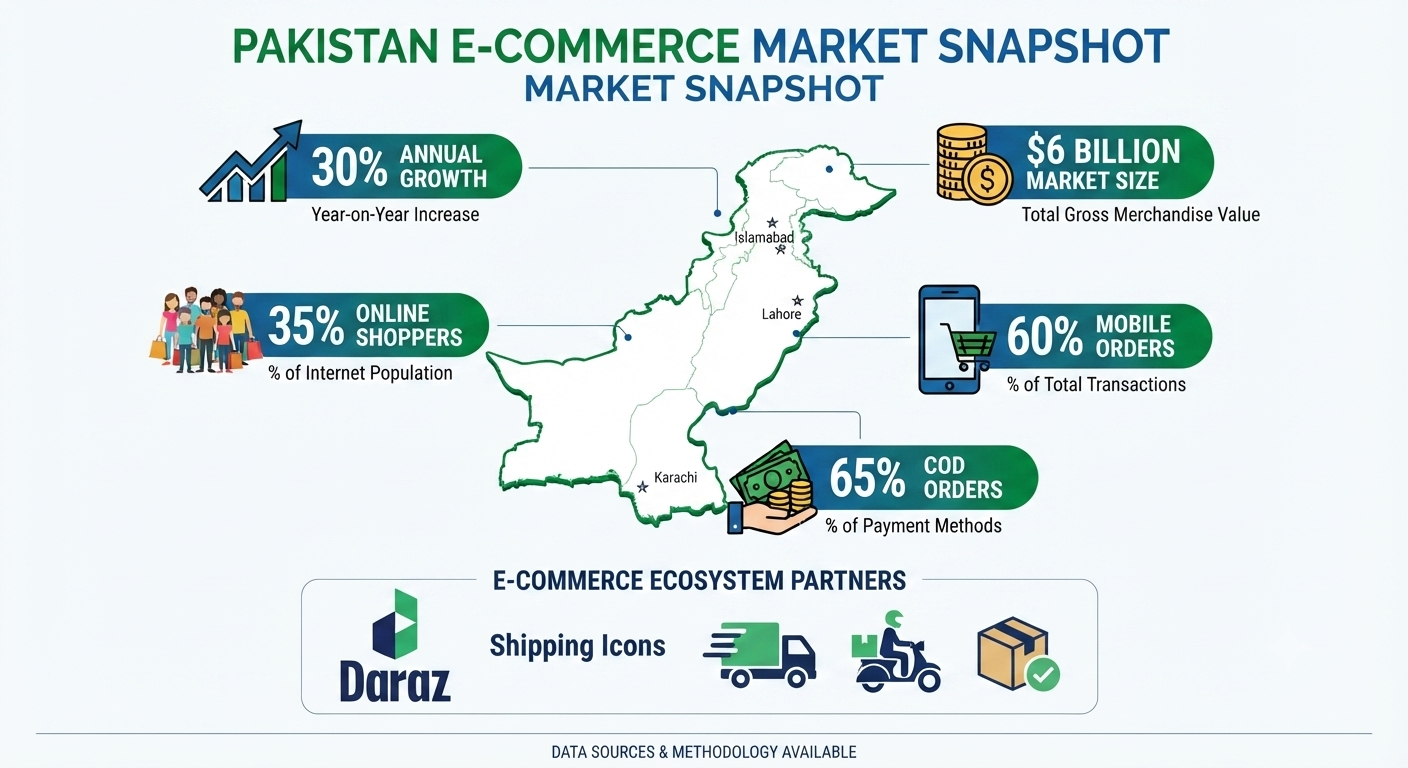
Pakistan E-Commerce Market Overview
- 📈 30% annual growth rate
- 📱 60% of orders through mobile
- 💰 $6 billion+ market size by 2026
- 🇵🇰 35% of Pakistanis shop online
- 🛒 65% orders are Cash on Delivery (COD)
Popular Platforms in Pakistan
- Daraz – #1 marketplace (millions of users)
- Telemart – Second largest
- Foodpanda – Food delivery
- Shopify – Growing rapidly
- Facebook Marketplace – Local selling
Payment Methods in Pakistan
- Cash on Delivery (COD) – Most popular (65% orders)
- JazzCash – Mobile wallet
- Easypaisa – Mobile wallet
- Bank Transfers – Online banking
- Credit/Debit Cards – Limited penetration
Cash on Delivery (COD) in Pakistan
What is COD? Customer orders and pays cash when the product is delivered.
Pros:
- ✅ Trust factor (customers pay after seeing product)
- ✅ Higher conversion rate
- ✅ No credit card needed
Cons:
- ❌ Return to Origin (RTO) issues (15-30%)
- ❌ Payment collection risk
- ❌ Cash handling issues
Return to Origin (RTO) Management
What is RTO? Return to Origin – when a customer cancels or delivery fails, the package returns to the seller.
RTO Rate in Pakistan: 15-30% (very high!)
Reasons for RTO:
- Customer not available
- Wrong address provided
- Order cancellation
- Cash shortage
- Quality issues
How to Reduce RTO:
- ✅ Address verification before shipping
- ✅ SMS reminders before delivery
- ✅ Call customer before delivery
- ✅ Offer discounts for pre-paid orders
- ✅ Use reliable couriers
- ✅ Track and follow up on orders
Shipping & Logistics in Pakistan
| Courier | Best For | Charges | Coverage |
|---|---|---|---|
| Leopards | All Pakistan | PKR 150-500 | ✅ All cities |
| TCS | All Pakistan | PKR 200-600 | ✅ All cities |
| M&P | All Pakistan | PKR 150-400 | ✅ All cities |
| Daraz Express | Daraz sellers | PKR 100-300 | ✅ Major cities |
➡️ Read Complete Pakistan E-Commerce Guide → (Link to be added)
📈 Marketing & Growth Strategies
Getting traffic to your e-commerce store is the most important step. Here are proven strategies to attract customers.
1. Facebook/Instagram Ads
Facebook and Instagram are the best advertising platforms for e-commerce in Pakistan.
How to Start:
- Create a Facebook Page
- Install Meta Pixel on your website
- Create ad campaigns with targeting
- Target Pakistan audience
- Optimize based on results
Budget: $5-20/day (testing phase)
Best Ad Types:
- 🖼️ Image Ads – Product showcase
- 🎥 Video Ads – Product demos
- 🛒 Carousel Ads – Multiple products
- 📱 Collection Ads – Shopping experience
2. TikTok Ads
TikTok is growing extremely fast in Pakistan. Great for viral product content.
Best For:
- Product demonstrations
- Unboxing videos
- Behind-the-scenes
- Influencer collaborations
Budget: $10-30/day
3. SEO (Search Engine Optimization)
SEO helps your store rank on Google for free, organic traffic.
E-Commerce SEO Checklist:
- ✅ Optimize product titles with keywords
- ✅ Write detailed product descriptions
- ✅ Use H1, H2, H3 headings properly
- ✅ Add meta descriptions for each page
- ✅ Use internal links between products
- ✅ Add schema markup (Product, FAQ)
- ✅ Optimize images with alt text
- ✅ Create a sitemap.xml
4. AEO (Answer Engine Optimization)
AEO helps your content appear in AI assistants like ChatGPT, Gemini, and voice search.
AEO Checklist:
- ✅ Add FAQ schema to your pages
- ✅ Write clear, concise answers
- ✅ Use structured data markup
- ✅ Create llms.txt file
- ✅ Optimize for voice search (questions)
5. Email Marketing
Email marketing has the highest ROI in e-commerce. Build an email list and send campaigns.
Best Email Types:
- 📧 Welcome emails – New subscribers
- 🛒 Abandoned cart emails – Recover lost sales
- 🎁 Promotional emails – Discounts and offers
- 📦 Order confirmation emails – Transactional
- 💬 Follow-up emails – Customer feedback
6. Social Media Strategy
Social media builds brand awareness and community.
Platforms for Pakistan:
- 📱 Facebook – Largest audience
- 📱 Instagram – Visual products
- 🎵 TikTok – Viral potential
- 💬 WhatsApp – Direct selling
Content Strategy:
- 🎬 Daily reels – Product showcases
- 📸 Product photos – High quality
- 📝 Educational posts – Solve customer problems
- 🎥 Behind-the-scenes – Build trust
- 💬 Customer testimonials – Social proof
➡️ Read Complete Marketing Guide → (Link to be added)
👥 Team Requirements
Your team size depends on your business stage. Here’s what each stage looks like.
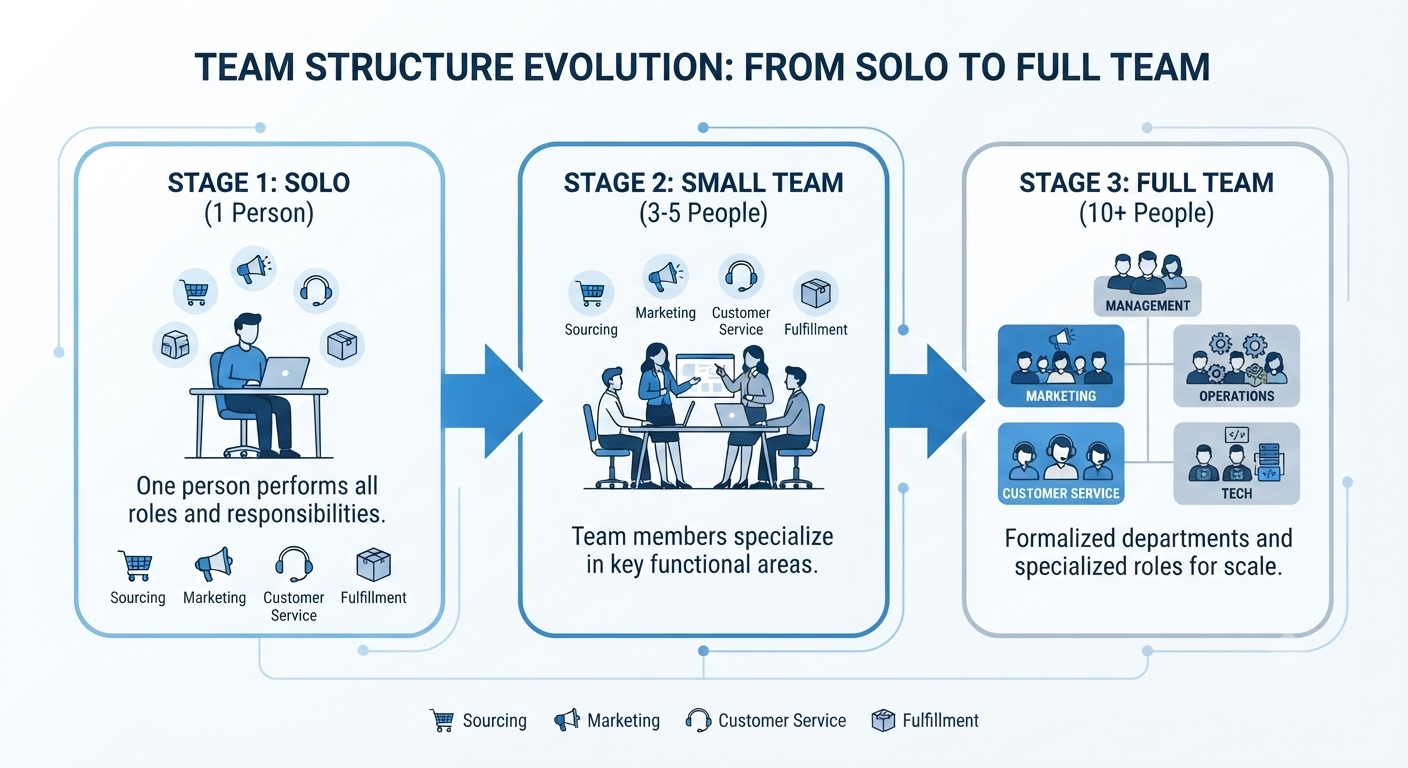
Stage 1: Solo Setup (You Do Everything)
- ✅ Product sourcing
- ✅ Marketing & Ads
- ✅ Customer service
- ✅ Order fulfillment
Best for: Starting with limited budget. You learn everything by doing.
Stage 2: Small Team (3-5 People)
| Role | People | Responsibilities |
|---|---|---|
| Product Sourcing | 1 | Find products, negotiate with suppliers |
| Marketing & Ads | 1 | Run ads, manage social media |
| Customer Service | 1 | Handle inquiries, returns, support |
| Fulfillment | 1 | Pack & ship orders |
| Operations | 1 | Inventory, finance, strategy |
Stage 3: Full Team (10+ People)
| Department | People | Responsibilities |
|---|---|---|
| Management | 2 | Strategy, finance, HR |
| Marketing | 3-5 | Ads, SEO, social media, content |
| Operations | 3-5 | Sourcing, inventory, fulfillment |
| Customer Service | 2-3 | Support, returns |
| Tech | 2-3 | Website, IT, development |
➡️ Read Complete Team Guide → (Link to be added)
📋 Legal Compliance in Pakistan
Here are the legal requirements for running an e-commerce business in Pakistan.
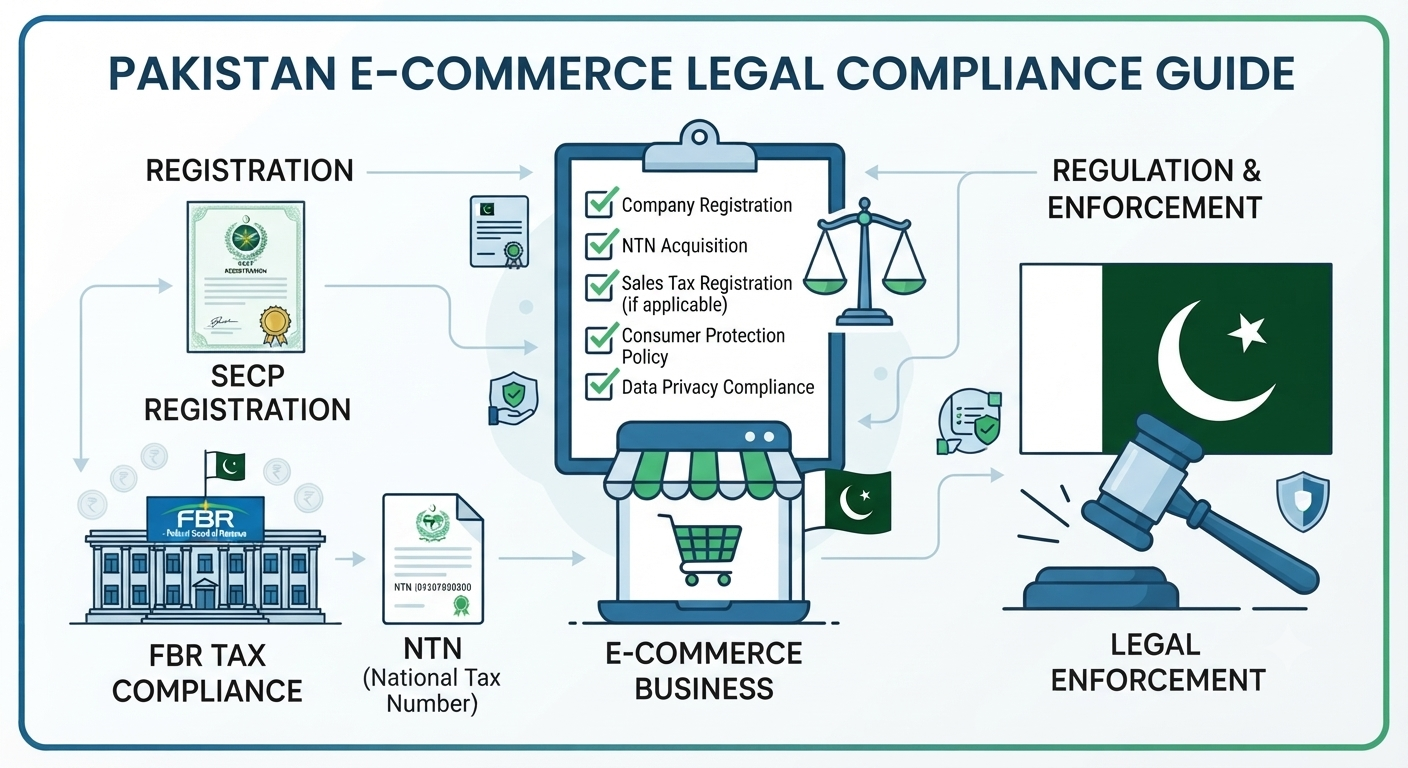
| Requirement | Status | Details |
|---|---|---|
| Business Registration | ✅ Required | Register with SECP (Sole Proprietorship or Company) |
| NTN (National Tax Number) | ✅ Required | Get from FBR |
| Sales Tax Registration | ⚠️ Required (if turnover > PKR 10M) | Register with FBR |
| Privacy Policy | ✅ Recommended | Must have on website |
| Terms & Conditions | ✅ Recommended | Must have on website |
| Return/Refund Policy | ✅ Recommended | Must be clearly stated |
➡️ Read Complete Legal Guide → (Link to be added)
✅ Success vs Failure Analysis
Understanding what makes an e-commerce business succeed or fail is crucial. Here’s an honest analysis.
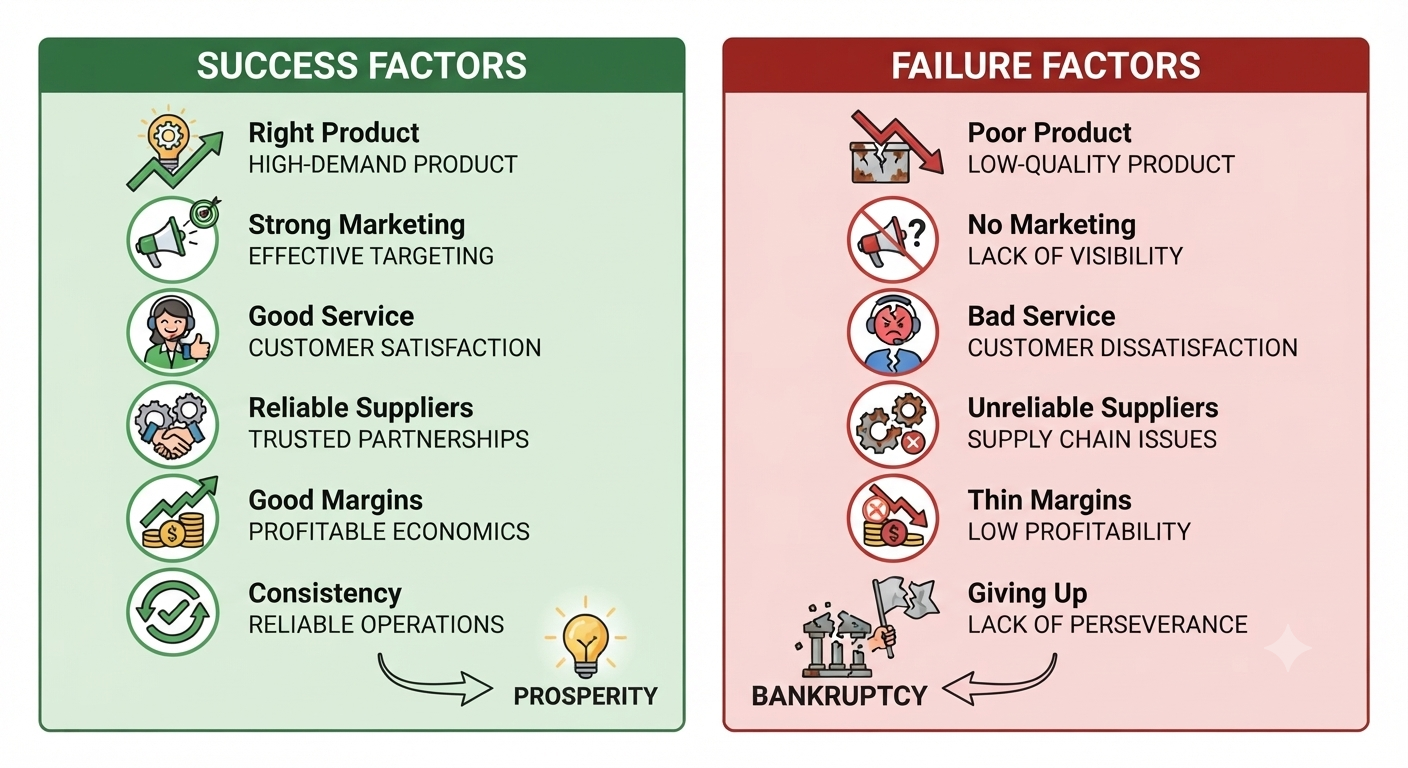
Success Factors ✅
- Right Product Selection: High demand, low competition
- Strong Marketing Strategy: Consistent ads and content
- Good Customer Service: Fast responses, clear communication
- Reliable Suppliers: Quality products, on-time delivery
- Good Profit Margins: 30%+ margins
- Consistency: Daily effort, don’t give up
Failure Factors ❌
- Poor Product Selection: No demand, too much competition
- No Marketing Budget: No traffic, no sales
- Bad Customer Service: Slow responses, angry customers
- Unreliable Suppliers: Poor quality, shipping delays
- Thin Profit Margins: 10% or less margins
- Giving Up Too Early: Before 3-6 months of effort
Pakistan-Specific Challenges 🇵🇰
| Challenge | Solution |
|---|---|
| High RTO (15-30%) | Pre-paid discounts, address verification |
| COD Dependency | Introduce pre-paid options |
| Shipping Delays | Use reliable couriers (TCS, Leopards) |
| Digital Literacy | Simple, clear instructions |
| Payment Trust | Use trusted payment gateways |
🚀 Emerging Trends in E-Commerce
Stay ahead of the competition by understanding these emerging trends.
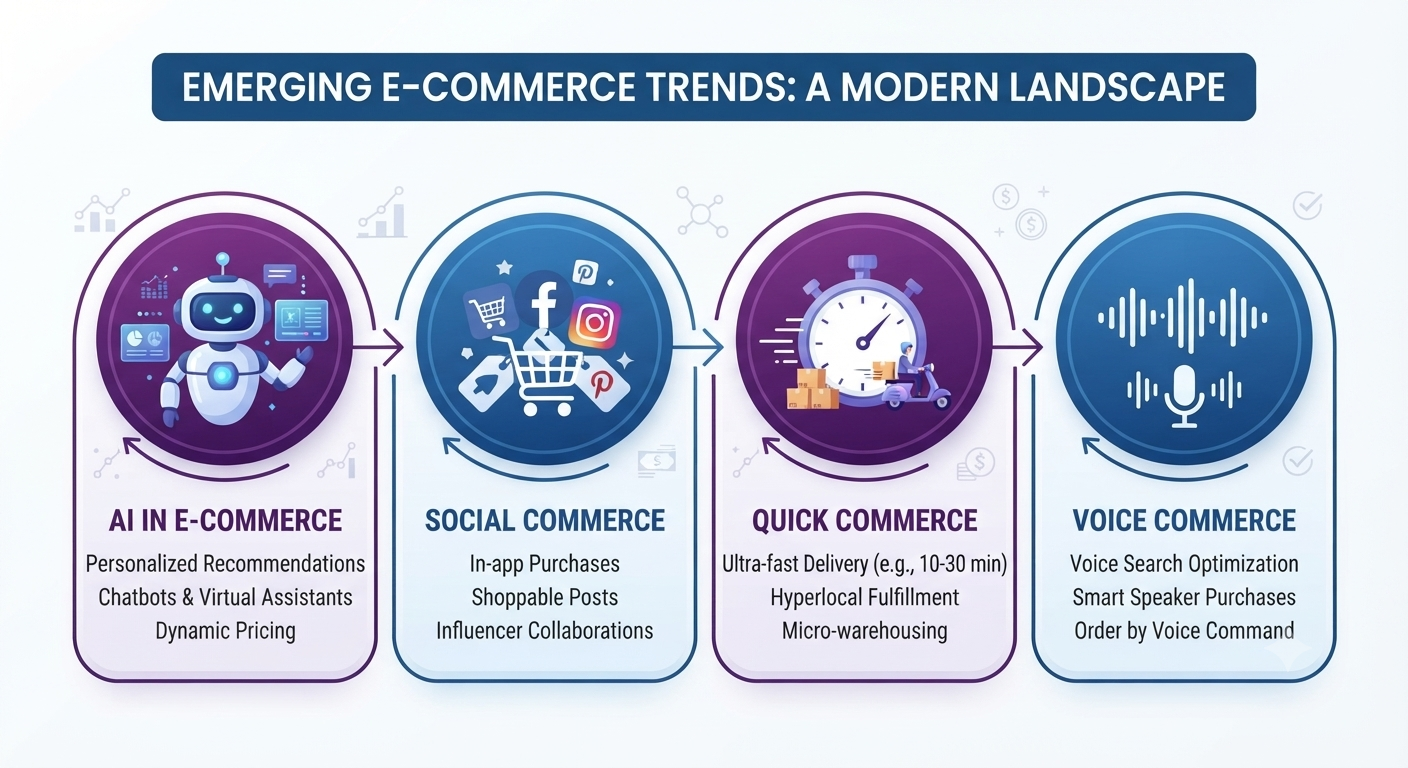
1. AI in E-Commerce
Artificial Intelligence is transforming e-commerce:
- 🤖 Product recommendations (personalization)
- 💬 Chatbots for customer service
- ✍️ AI-generated product descriptions
- 🎯 AI-powered ads optimization
- 📊 Predictive analytics for inventory
2. Social Commerce
Selling directly through social media platforms:
- 📱 Instagram Shop
- 🎵 TikTok Shop
- 📘 Facebook Marketplace
- 💬 WhatsApp Business (catalog + orders)
3. Quick Commerce (Under 30-minute Delivery)
Ultra-fast delivery services:
- 🍔 Food delivery (Foodpanda)
- 🛒 Grocery delivery (Krave Mart)
- 📦 General delivery (D-Mart)
- 💊 Pharmacy delivery
4. Voice Commerce
Shopping through voice assistants:
- 🎤 Amazon Alexa shopping
- 🤖 Google Assistant ordering
- 🗣️ Voice search optimization
❓ Frequently Asked Questions
What is the best e-commerce model for beginners?
Dropshipping is best for beginners because:
- ✅ Low investment ($100-300)
- ✅ No inventory risk
- ✅ Easy to start (Shopify + AliExpress)
- ✅ No shipping headaches
Your only focus is marketing and customer service.
>a href=”https://trueseekway.com/start-online-business/e-commerce-complete-guide/dropshipping-complete-guide/”➡️ Read Complete Dropshipping Guide →
How to start e-commerce in Pakistan?
Step-by-step process:
- Choose a platform: Daraz (easiest) or Shopify (best)
- Find products: Local suppliers or AliExpress
- Set up payment: JazzCash, Easypaisa, or COD
- Start marketing: Facebook/Instagram ads
- Fulfill orders: Use TCS, Leopards, or Daraz shipping
Investment needed: $100-500 (for ads and initial stock)
➡️ Read Complete Pakistan E-Commerce Guide →
How much profit can I make from e-commerce?
Profit margins by model:
- Dropshipping: 10-30% profit margin
- Private Label: 30-60% profit margin
- Affiliate: 10-50% commission
- Wholesale: 10-30% profit margin
Monthly earning potential:
- 💵 Starting: $500-1000/month
- 💰 Scaling: $2000-5000/month
- 🚀 Established: $10,000+/month
What are the biggest challenges in e-commerce?
Top 5 challenges:
- Customer acquisition: Getting traffic is expensive
- Return to Origin (RTO): 15-30% returns in Pakistan
- Supplier issues: Quality control, shipping delays
- Competition: Many sellers competing on price
- Payment trust: COD dependency in Pakistan
💡 Solution: Focus on product quality, customer service, and pre-paid discounts.
Do I need a website to start e-commerce?
No! You can start without a website:
- ✅ Daraz: Marketplace built for Pakistan
- ✅ WhatsApp Business: Sell through WhatsApp
- ✅ Facebook Marketplace: Sell locally
- ✅ Instagram Shop: Sell on Instagram
Website is recommended once you scale.
Shopify vs WooCommerce vs Daraz – which is best?
| Platform | Best For | Price | Pakistan Support |
|---|---|---|---|
| Shopify | All-in-one, beginners | $29/month | ✅ Yes |
| WooCommerce | WordPress users | Free | ✅ Yes |
| Daraz | Pakistan sellers | Free (commission) | ✅ Pakistan |
➡️ Read Complete Platform Comparison →
What is Return to Origin (RTO) and how to reduce it?
RTO = Return to Origin – When a customer cancels or delivery fails, the package returns to the seller.
RTO Rate in Pakistan: 15-30% (very high!)
How to reduce RTO:
- ✅ Address verification before shipping
- ✅ SMS reminders before delivery
- ✅ Call customer before delivery
- ✅ Offer discounts for pre-paid orders
- ✅ Use reliable couriers
Is dropshipping legal in Pakistan?
Yes, 100% legal!
You need:
- ✅ Business registration (if scaling)
- ✅ NTN (National Tax Number)
- ✅ Sales Tax registration (if turnover > PKR 10M)
⚠️ Make sure your products are not counterfeit.
➡️ Read Complete Legal Guide →
How much does it cost to start e-commerce in Pakistan?
Minimum investment: $100-500
| Item | Cost (PKR) | Cost (USD) |
|---|---|---|
| Domain + Hosting | PKR 5,000-10,000 | $20-40 |
| Shopify Subscription | PKR 8,000 | $29/month |
| Product Samples | PKR 5,000-15,000 | $20-50 |
| Initial Ads Budget | PKR 15,000-50,000 | $50-150 |
| Total | PKR 33,000-83,000 | $119-269 |
Can I start e-commerce without skills?
Yes! Start with these models:
- ✅ Dropshipping: No skills needed (learn as you go)
- ✅ Affiliate Marketing: Share links, earn commissions
- ✅ Reseller: Buy and sell on social media
- ✅ Daraz Seller: List products, Daraz handles shipping
Which platform is best for Pakistan e-commerce?
For beginners: Daraz (built-in audience, easy start)
For brand builders: Shopify (full control, professional)
For WordPress users: WooCommerce (free, customizable)
What are the best products to sell online in Pakistan?
Top-selling categories:
- 👕 Clothing & Fashion (highest demand)
- 📱 Electronics & Accessories
- 💄 Cosmetics & Beauty
- 🏠 Home & Kitchen
- 📚 Books & Stationery
- 🎁 Gifts & Novelties
- 🍼 Baby & Kids Products
How to get traffic to my e-commerce store?
Free strategies:
- ✅ SEO (Optimize for Google)
- ✅ Social media (Instagram, Facebook, TikTok)
- ✅ Content marketing (Blog posts, videos)
- ✅ WhatsApp Business (Direct selling)
Paid strategies:
- 💰 Facebook/Instagram Ads
- 💰 TikTok Ads
- 💰 Google Ads
🚀 Need Professional Help?
Building an e-commerce store can be overwhelming. Let the experts handle it for you.
💼 RikazoTech.com – Your E-Commerce Partner
| Service | Details |
|---|---|
| Website Development | Custom Shopify, WooCommerce, or Daraz stores |
| Product Sourcing | Find reliable suppliers and products |
| Marketing Setup | Facebook Ads, TikTok Ads, Google Ads |
| SEO & AEO | Rank on Google and AI assistants |
| Full Support | End-to-end e-commerce solutions |
What you get:
- ✅ Professional store design
- ✅ Payment gateway setup (JazzCash, Easypaisa, Stripe)
- ✅ Product listing optimization
- ✅ Marketing strategy
- ✅ Ongoing support
📞 Book Your Free Consultation Today!
👉 Visit RikazoTech.com or contact us for a free strategy session.
📚 Related Guides
Start your journey with these complete guides:
| Guide | Link |
|---|---|
| 🏠 Home | TrueSeekWay Home → |
| 💼 Start Online Business | Complete Guide → |
| 🛒 Dropshipping Complete Guide | Read Guide → |
| 🛍️ Shopify Complete Guide | Read Guide → |
| 📦 Daraz Seller Guide | Read Guide → |
| 📈 E-Commerce Marketing Guide | Read Guide → |
| 🌍 Pakistan E-Commerce Guide | Read Guide → |
| 🛠️ E-Commerce Tools Guide | Read Guide → |
TrueSeekWay – Your complete guide to business, career, and success.